
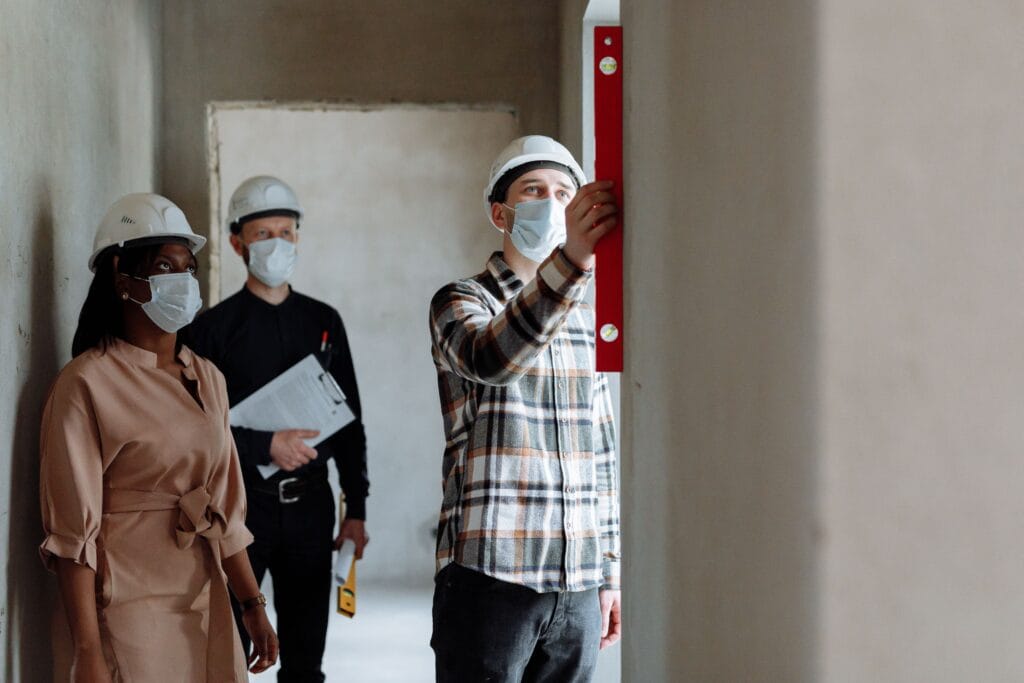
Gypsum board has become the default choice for interior walls and ceilings across the Gulf, and for good reasons. It goes up quickly, takes a clean finish, adds fire protection and costs little to maintain. This guide covers the benefits that matter to building owners and facility teams.
In this article
What gypsum board actually is
Gypsum board is a panel with a core of gypsum, a mineral, pressed between two sheets of heavy paper. You will also hear it called gypsum wallboard, plasterboard or drywall gypsum board. The names vary by region, but the product is the same family.
It is a building material designed for interior use. It forms partitions, wall linings and suspended ceilings. Different grades exist: standard boards for dry rooms, moisture-resistant boards for kitchens and bathrooms, and fire-rated boards for protected escape routes and risers. Picking the wrong grade is the most common mistake we see, so it is worth settling the specification before anyone orders sheets.
Speed and clean installation
This is where drywall gypsum board earns its place. Boards are screwed to a light metal frame, joints are taped and jointed, and the surface is ready for paint. There is no wet trade to wait on, no curing time and very little mess compared with block and plaster.
For a fit-out with a fixed handover date, that matters. Offices, retail units and apartments can have partitions erected in days, and other trades such as electrical and cabling can follow straight away. The frame cavity also gives you somewhere to run services without chasing into masonry.
Our team handles this work as part of its gypsum work services, from new partitions to ceiling replacement in occupied buildings.
Fire resistance and safety
The gypsum core holds chemically bound water. When heat reaches the board, that water is released slowly as steam, which holds back the temperature on the far side of the panel. Fire-rated boards add reinforcement to the core so the panel stays in place longer.
That does not make a board a fire solution by itself. The rating belongs to the tested system: board type, thickness, number of layers, framing, fixings and how penetrations are sealed. A neat hole cut for a cable and left open can undo the whole detail. If your building depends on compartment walls, have the sealing checked as part of regular fire safety system maintenance, not only at handover.
A fire rating belongs to the whole assembly, not to the board on its own.
Design freedom with a gypsum board ceiling
A gypsum board ceiling is the feature most clients picture first. Boards can be fixed flat for a plain finish, or built into drops, coves, bulkheads and recesses. Curved sections are possible with flexible board or by wetting and bending standard sheets on site.
Because the ceiling hides ductwork, wiring and pipes, it also tidies the room. Lighting can be recessed, and access panels can be placed where technicians will need them. Plan those panels early. Nothing frustrates a maintenance team more than a beautiful ceiling with no way to reach the valve above it.
The surface takes paint well, which is why ceiling work and professional painting are often scheduled together.
Sound, comfort and cooling loads
A single layer of board on a frame is not a soundproof wall, and it is wise to say so plainly. Acoustic performance improves when you use two layers, fill the cavity with mineral wool and avoid rigid contact between the two faces of the partition. Done properly, board partitions give good privacy between meeting rooms and offices.
There is a comfort angle too. Insulation placed in the cavity or above a ceiling cuts heat gain from roofs and external walls, which helps air conditioning in a hot climate. Smooth, sealed board surfaces are also easy to keep clean, a small but real benefit in healthcare, education and food areas.
Maintenance and repair
Damage happens in every building. A trolley hits a wall, a trade drops a ladder, a leak stains a ceiling tile. With board, the repair is local: cut out the damaged section, patch it, joint, sand and repaint. You do not rebuild the room.
That ease is a real advantage for facility managers, but only when someone is watching. Small stains and cracked joints are early warnings of leaks or movement. Including board surfaces in a planned inspection round under an annual maintenance contract catches those signs before they become a ceiling collapse or a mould problem.
Where gypsum board needs care
Standard board and water do not mix. Prolonged moisture softens the core and feeds mould, so wet areas need moisture-resistant board, proper sealing and a dependable waterproofing layer behind it. Ceilings below roofs, plant rooms and bathrooms deserve extra attention for the same reason.
Heavy items are another trap. Shelves, wall-mounted screens and cabinets need proper fixings or backing plates in the frame, not a plug in the board. Specify those loads early and mark them on the drawings.
None of this counts against the material. It simply means that board rewards good detailing and punishes shortcuts. If you are planning a new partition layout, a ceiling upgrade or repairs after water damage, our team can assess the space and recommend the right grade and system.